
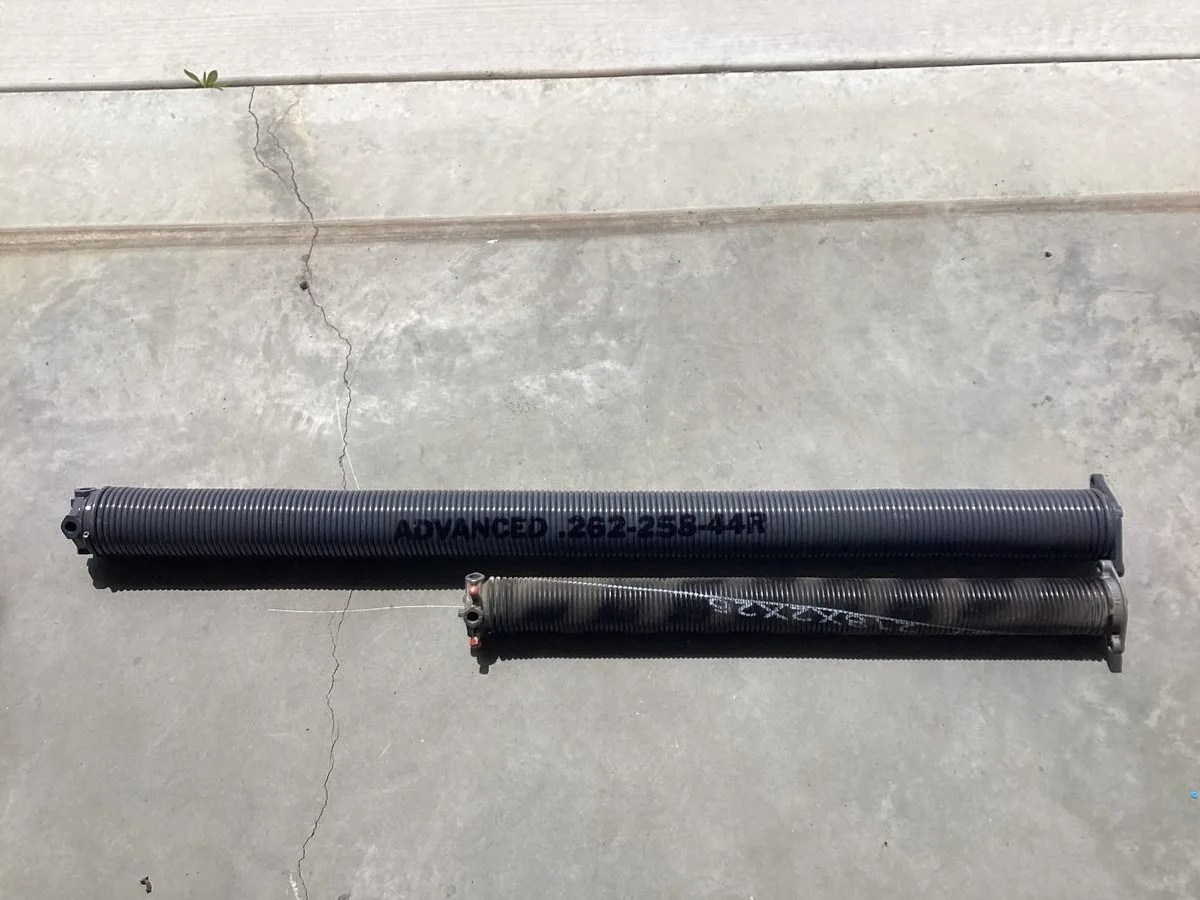
Standard garage door torsion springs last 15,000 to 20,000 cycles, which translates to roughly 7 to 12 years for most households. Extension springs last slightly less at 10,000 to 15,000 cycles, or about 5 to 9 years. High-cycle and lifetime warranty springs can last 25,000 to 50,000+ cycles. Factors like usage frequency, door weight, maintenance, and Utah’s temperature extremes all affect lifespan. Advanced Door is Utah’s #1 rated garage door company – 4.9 stars, 30,000+ reviews, family owned since 1994, and the only company in Utah offering a lifetime warranty on both parts and labor. Call (844) 971-3667 for a free spring inspection.
Last updated: May 2026
Summarize this guide with AI
Table of Contents
- How Long Do Garage Door Springs Last? (The Short Answer)
- Understanding Cycle Counts: What They Mean for Your Springs
- 8 Factors That Determine Your Spring’s Lifespan
- Torsion vs Extension Spring Lifespan Comparison
- How Utah’s Climate Affects Spring Lifespan
- Spring Quality Tiers: From Economy to Lifetime
- How to Calculate Your Spring’s Remaining Life
- 7 Warning Signs Your Springs Are Nearing End of Life
- How to Extend Your Garage Door Spring Lifespan
- When to Replace Springs (Before They Break)
- Why Advanced Door Uses Lifetime Warranty Springs
- Frequently Asked Questions
How Long Do Garage Door Springs Last? (The Short Answer)
If you are wondering how long do garage door springs last, the answer depends on the type of spring and how often you use your garage door. Here is the quick breakdown:
- Standard torsion springs: 15,000 to 20,000 cycles (7 to 12 years for most families)
- Extension springs: 10,000 to 15,000 cycles (5 to 9 years)
- High-cycle torsion springs: 25,000 to 50,000 cycles (12 to 20+ years)
- Lifetime warranty springs: 50,000+ cycles (20 to 30+ years)
But those numbers only tell part of the story. A “cycle” means one full open-and-close of your garage door. How quickly you burn through those cycles depends on your daily usage, and how well the springs hold up over time depends on maintenance, installation quality, and Utah’s demanding climate.
The average American household opens and closes their garage door 3 to 5 times per day. That works out to roughly 1,100 to 1,800 cycles per year. At the high end, a family that uses the garage as their primary entrance might hit 8 to 10 cycles daily, cutting spring life nearly in half.
Pro Tip
Count how many times your household opens and closes the garage door in a typical day. Multiply by 365 and you will know your annual cycle count. This is the single most important number for predicting when your springs will need replacement.
Understanding Cycle Counts: What They Mean for Your Springs
Every garage door spring is manufactured with a specific cycle rating. Think of it like the odometer on your car. The spring does not care how old it is in calendar years. It cares how many times it has wound and unwound.
One cycle equals one complete open-and-close sequence. When the door goes up, the spring unwinds and releases stored energy. When the door comes back down, the spring winds tight again, storing energy for the next opening. Each cycle creates microscopic stress fractures in the spring wire that accumulate over time until the metal eventually fails.
Here is what typical daily usage looks like for different households:
- Low usage (2 to 3 cycles/day): Retired couple, single-car household, or vacation home. About 730 to 1,100 cycles per year.
- Average usage (4 to 5 cycles/day): Two-car family with daily commuters. About 1,460 to 1,825 cycles per year.
- Heavy usage (6 to 8 cycles/day): Active family with teenagers, frequent in-and-out, deliveries. About 2,190 to 2,920 cycles per year.
- Very heavy usage (10+ cycles/day): Home business, multiple drivers, garage as primary entrance. About 3,650+ cycles per year.
At average usage (4 cycles per day), a standard 15,000-cycle torsion spring lasts about 10 years. At heavy usage (8 cycles per day), that same spring only lasts about 5 years. The spring itself has not changed. Your usage pattern is the variable.
Action Step
Keep a mental note of your household garage door usage for one week. If you are consistently above 6 cycles per day, standard springs may not give you the longevity you expect. Talk to your technician about high-cycle or lifetime warranty springs at your next service visit.
8 Factors That Determine Your Spring’s Lifespan
Cycle count is the foundation, but eight factors determine whether your springs hit their rated lifespan or fall short.
1. Spring Quality and Wire Grade
Not all springs are created equal. The grade of steel wire, the precision of the coiling, and the quality of the coating all affect how long the spring resists fatigue. Cheap springs made from lower-grade wire can fail at 60 to 70 percent of their rated cycle life. Premium springs from reputable manufacturers consistently reach or exceed their ratings.
2. Usage Frequency
As covered above, daily cycle count is the biggest controllable factor. Every unnecessary open-close burns through your spring’s finite lifespan. Smart garage door systems that track cycles can help you monitor this.
3. Door Weight and Balance
Springs are sized for a specific door weight. If your door is heavier than the springs are rated for (wrong spring size, or a door that has gained weight from moisture absorption in wood panels), the springs work harder every cycle. This accelerated stress shortens lifespan significantly. A properly balanced garage door should stay in place when manually lifted halfway. If it drifts up or crashes down, the springs are either too strong or too weak.
Safety Warning
Never attempt to adjust torsion spring tension yourself. Torsion springs are under extreme tension and can cause serious injury or death if they release unexpectedly. Always call a trained technician for spring adjustments. Call Advanced Door at (844) 971-3667 for safe, professional service.
4. Lubrication and Maintenance
Springs that are properly lubricated experience less friction and corrosion, both of which accelerate fatigue. A quality garage door lubricant (white lithium grease or silicone-based spray) applied to the spring coils every 3 to 4 months can extend spring life by 20 to 30 percent. Learn the right technique in our complete lubrication guide.
5. Temperature Extremes
Metal expands in heat and contracts in cold. In Utah, where winter temperatures can drop below zero and summer temperatures exceed 100 degrees, springs endure constant thermal cycling that adds stress beyond the mechanical cycling. Cold steel is more brittle and more prone to fracture. This is why spring failures spike during Utah’s coldest months.
6. Rust and Corrosion
Rust does not just look bad. It weakens the spring wire at a molecular level by creating pits and surface imperfections where stress fractures initiate. Along the Wasatch Front, road salt tracked into garages during winter is a major corrosion accelerator. Regular lubrication creates a protective barrier against moisture and salt. For a deeper dive on corrosion, see our rust prevention and repair guide.
7. Proper Initial Installation
Springs that are wound to the correct number of turns and properly secured will reach their full cycle life. Springs that are over-wound or under-wound from day one start with built-in stress that shortens their lifespan. This is one of the biggest reasons cheap installation costs you more in the long run. Our torsion spring replacement guide explains what proper installation looks like.
8. Single vs Dual Spring Setup
Doors with two springs share the load between them, meaning each spring handles roughly half the work. Single-spring setups put all the stress on one spring. Dual-spring systems not only last longer per spring, they also provide a safety margin. If one spring breaks, the other prevents the door from crashing down. Most professional installers recommend dual springs for any standard residential door.
Pro Tip
If your garage door currently has a single torsion spring and it breaks, ask your technician about upgrading to a dual-spring setup during the replacement. The additional cost is modest, and you get longer spring life plus a significant safety improvement.
Torsion vs Extension Spring Lifespan Comparison
The two main types of garage door springs have different lifespans, different failure modes, and different maintenance needs. For a complete comparison of how they work, see our torsion vs extension springs guide.
| Feature | Torsion Springs | Extension Springs |
|---|---|---|
| Standard Cycle Life | 15,000 to 20,000 cycles | 10,000 to 15,000 cycles |
| Typical Lifespan | 7 to 12 years | 5 to 9 years |
| High-Cycle Option | Yes (25,000 to 50,000+) | Limited options |
| Failure Mode | Snaps in place on torsion bar | Can fly off if safety cable missing |
| Balance Over Time | Gradual, smooth degradation | More erratic as springs stretch |
| Cold Weather Impact | Moderate (shorter coils resist cold) | Higher (long stretched coils more vulnerable) |
| Maintenance Needs | Lubrication every 3 to 4 months | Lubrication + safety cable inspection |
| Cost to Replace | $200 to $350 (pair) | $150 to $250 (pair) |
| Best For | Most residential doors, heavy doors | Lighter single-car doors, low ceilings |
Torsion springs are the industry standard for modern residential garage doors and the type we install on the vast majority of jobs at Advanced Door. They last longer, operate more smoothly, fail more safely, and offer high-cycle and lifetime options that extension springs simply do not match.
Utah Note
If your home has extension springs and you live anywhere along the Wasatch Front, consider upgrading to torsion springs at your next replacement. Utah’s temperature extremes and road salt conditions hit extension springs harder because of their exposed, stretched-out design. The upgrade typically costs $100 to $200 more but can double your spring lifespan.
How Utah’s Climate Affects Spring Lifespan
Utah is one of the hardest states in the country on garage door springs. The combination of extreme temperature swings, dry air, road salt, and elevation creates conditions that can shorten spring life by 20 to 40 percent compared to mild-climate states.
Winter Cold and Metal Fatigue
When temperatures drop below freezing, steel becomes more brittle and less flexible. A spring that flexes smoothly at 70 degrees resists bending more at 10 degrees. This increased resistance means more stress per cycle during winter months. In Logan and Cache Valley, where overnight temperatures regularly hit minus 10 to minus 20 degrees in January, springs experience significant cold-related stress for 3 to 4 months of the year. Our winter garage door problems guide covers this in depth.
Temperature Swings (Spring and Fall)
Utah’s notorious 40 to 50 degree daily temperature swings in spring and fall cause repeated thermal expansion and contraction in the spring wire. A spring that starts the morning at 25 degrees and warms to 65 degrees by afternoon is experiencing thermal cycling on top of mechanical cycling. This dual stress is particularly intense in mountain communities and valley floors where inversions trap cold air overnight.
Wasatch Front Road Salt Corrosion
UDOT applies thousands of tons of road salt along the Wasatch Front every winter. Cars and trucks track this salt into garages, where it settles on springs, tracks, and hardware. Salt accelerates corrosion dramatically. A spring in a Salt Lake City garage that never gets lubricated can develop visible rust pitting within 2 to 3 winters. That pitting becomes the starting point for fatigue cracks.
Great Salt Lake Salt Aerosols
Homes near the Great Salt Lake (parts of Ogden, Syracuse, Clearfield, and the west side of the valley) face airborne salt that does not need to be tracked in by vehicles. It is in the air. This is the same phenomenon that makes coastal homes harder on metal hardware. Regular lubrication is not optional in these areas.
Elevation and Dry Air
Utah’s high elevation means lower humidity year-round. While this reduces some moisture-related corrosion, it also means lubricants evaporate faster. A lubrication schedule that works in a humid climate needs to be more frequent in Utah. Springs in the Draper foothills or mountain communities above 5,000 feet should be lubricated every 2 to 3 months instead of the standard 3 to 4 month interval.
Utah Note
Utah’s climate conditions mean you should plan for roughly 15 to 25 percent fewer years from your springs compared to national averages. A spring rated for 10 years in a temperate climate might realistically give you 7 to 8 years along the Wasatch Front. Factor this into your replacement planning and budget.
Not Sure How Much Life Your Springs Have Left?
Our technicians can inspect your springs and tell you exactly where they stand. Free estimates, no pressure.
Spring Quality Tiers: From Economy to Lifetime
Not all replacement springs are the same, and the tier your installer uses has a massive impact on how long your springs last. Here is what you will find on the market:
| Tier | Cycle Rating | Est. Lifespan | Typical Cost | Best For |
|---|---|---|---|---|
| Economy | 10,000 | 3 to 7 years | $150 to $200 (pair, installed) | Rental properties, homes being sold |
| Standard | 15,000 to 20,000 | 7 to 12 years | $200 to $350 (pair, installed) | Average households |
| High-Cycle | 25,000 to 50,000 | 12 to 20+ years | $300 to $500 (pair, installed) | Active families, primary entrance |
| Lifetime Warranty | 50,000+ | 20 to 30+ years | $400 to $600+ (pair, installed) | Long-term homeowners, heavy use |
The difference between tiers comes down to wire quality, coiling precision, and coating. Economy springs use thinner or lower-grade steel wire that fatigues faster. Lifetime warranty springs use premium oil-tempered wire with tighter tolerances and protective coatings that resist corrosion.
When you compare cost per year of service, higher-tier springs almost always win. An economy spring at $175 lasting 5 years costs $35 per year. A lifetime warranty spring at $500 lasting 25 years costs $20 per year, and you avoid the inconvenience and safety risk of repeated failures.
Pro Tip
When getting spring replacement quotes, always ask what cycle rating the springs are. Many companies advertise low prices but install economy-tier springs. You should know exactly what you are paying for. For a detailed cost breakdown, see our spring replacement cost guide.
How to Calculate Your Spring’s Remaining Life
If you know when your springs were installed and your approximate daily usage, you can estimate how much life is left. Here is a simple formula:
Step 1: Determine your daily cycle count. Count how many times your garage door opens and closes in a typical day. Each open-close pair is one cycle.
Step 2: Calculate your annual cycles. Multiply your daily count by 365.
Step 3: Calculate total cycles used. Multiply annual cycles by the number of years since installation.
Step 4: Compare to your spring’s rating. If you do not know the rating, assume 15,000 to 20,000 for standard torsion springs or 10,000 for extension springs.
Example: A family that opens their garage door 5 times per day has used approximately 1,825 cycles per year. After 8 years, that is 14,600 cycles. On a 15,000-cycle spring, they are at 97 percent of rated life. Those springs could break any day.
Action Step
Do the math for your own springs. If you have used more than 80 percent of the rated cycle life, it is time to start planning a proactive replacement. Do not wait for the spring to snap at the worst possible moment. Call (844) 971-3667 for a free spring inspection.
Keep in mind this is an estimate. Springs in well-maintained systems with regular lubrication may exceed their rating. Springs in harsh conditions (unheated garages, salt exposure, improper balance) may fail well before their rating.
7 Warning Signs Your Springs Are Nearing End of Life
Springs rarely fail without warning. Here are the seven most common signs that your springs are approaching the end of their cycle life. For a much deeper dive into each sign, read our complete guide on signs your garage door spring is about to break.
1. The door feels heavier than it used to. As springs lose tension over time, they counterbalance less of the door’s weight. If lifting the door manually feels noticeably harder than it did a year ago, the springs are weakening.
2. The door does not stay open halfway. A properly balanced door with healthy springs should stay in place when you manually lift it to the midpoint and let go. If it drifts down, the springs have lost tension. See our guide on doors that will not stay open for more troubleshooting.
3. You hear new squeaking or grinding. Springs approaching failure often develop new sounds. Squeaking comes from metal fatigue and friction in the coils. Grinding can indicate a spring rubbing against the torsion bar or an adjacent spring. Learn more about garage door grinding noises.
4. Visible gaps in the spring coils. On a torsion spring, look for gaps between the coils that were not there before. Stretched or separated coils are a clear sign of fatigue and imminent failure.
5. Rust or corrosion on the coils. Visible rust means the spring wire is actively weakening. Surface rust can be addressed with lubrication, but deep pitting means the spring is compromised and should be replaced proactively.
6. The opener is straining harder. If your garage door opener sounds louder, runs longer, or vibrates more during operation, it may be compensating for weak springs. This puts extra stress on both the opener and the springs, accelerating failure of both components.
7. The door closes too fast. When springs lose tension, the door’s weight is less counterbalanced and gravity pulls it down faster during closing. If you notice the door closing faster or slamming at the bottom, the springs are nearing the end.
Safety Warning
If you notice any of these warning signs, do not ignore them. A broken spring can cause the door to drop suddenly, damage the opener, or injure someone standing nearby. Proactive replacement is always safer and cheaper than emergency repair. Call (844) 971-3667 to schedule an inspection.
How to Extend Your Garage Door Spring Lifespan
While you cannot make springs last forever, proper care can help you get the maximum number of cycles from your investment. Here are the most effective strategies:
Lubricate Every 3 to 4 Months
This is the single highest-impact maintenance task for spring longevity. Apply a quality white lithium grease or silicone-based garage door lubricant directly to the spring coils. Work it in by running the door up and down a few times. Lubrication reduces friction between coils, prevents rust, and helps the spring flex smoothly through its full range. Our lubrication guide walks you through the exact process.
In Utah, especially along the Wasatch Front during winter, increase to every 2 months to counteract road salt corrosion.
Keep the Door Balanced
An unbalanced door makes springs work harder on every cycle. Test your door’s balance every 6 months: disconnect the opener, manually lift the door halfway, and let go. If it stays put, the balance is good. If it drifts up or down, the springs may need adjustment. Never attempt to adjust torsion springs yourself. This is a job for a trained technician.
Follow a Maintenance Schedule
Springs do not exist in isolation. They are part of a system that includes rollers, tracks, cables, hinges, and the opener. When any of these components are worn or misaligned, the springs compensate by working harder. A complete maintenance schedule keeps the entire system in balance and maximizes spring life.
Seasonal Care for Utah Conditions
Utah’s seasons each bring unique challenges for your springs:
- Spring: Post-winter inspection and lubrication. Check for rust from salt exposure. See our spring maintenance checklist.
- Summer: Lubricate before peak heat. Check balance as the door may expand slightly. See our summer prep guide.
- Fall: Pre-winter lubrication and inspection. This is the last chance to address issues before cold makes springs more vulnerable. See our fall maintenance checklist.
- Winter: Keep the garage floor as salt-free as possible. Run the door a few times on extremely cold mornings to warm the springs gradually. See our winter problems guide.
Reduce Unnecessary Cycles
Every cycle counts. Small changes can add thousands of cycles to your spring’s remaining life:
- Use the pedestrian door instead of the garage door when you are just grabbing something
- Consolidate trips in and out rather than opening the door multiple times
- Make sure your remote and keypad are not accidentally triggering the door
- If you have a smart opener with scheduling, set it to auto-close once rather than multiple cycles
Pro Tip
A family that reduces their daily cycles from 6 to 4 saves approximately 730 cycles per year. Over 10 years, that is 7,300 extra cycles, potentially adding 3 to 5 years to their spring’s lifespan. Small habits add up.
Insulate Your Garage
An insulated garage door or insulated garage moderates temperature extremes inside the garage. This means your springs experience less thermal stress. A garage that stays between 30 and 90 degrees instead of minus 10 and 120 degrees is significantly easier on spring steel.
When to Replace Springs (Before They Break)
The worst time to replace garage door springs is after they break. A broken spring means:
- Your car may be trapped inside (or outside) the garage
- The door could have dropped on something or someone
- You need emergency repair which costs more and takes longer to schedule
- A snapped spring can damage the door, cables, or opener
- If you need to get the car out, you will need to open the door manually, which is difficult and risky with a broken spring
Proactive replacement makes more sense in every way. You can schedule it at your convenience, avoid emergency pricing, prevent collateral damage to other components, and make an informed decision about which spring tier to upgrade to.
As a general rule, consider proactive replacement when:
- Your springs are past 80 percent of their estimated cycle life
- You notice any of the 7 warning signs listed above
- Your springs are older than 8 to 10 years (regardless of apparent condition)
- One spring has already broken and you are replacing just the one (replace both at the same time)
- You are having other work done on the door and the springs are aging
Action Step
If your springs are 8+ years old or showing any warning signs, do not wait for them to snap. Schedule a free inspection with Advanced Door. Our technicians can assess your springs, estimate remaining life, and give you replacement options with transparent pricing. Call (844) 971-3667.
For a detailed breakdown of what replacement costs, see our complete spring replacement cost guide and our general repair cost guide.
Why Advanced Door Uses Lifetime Warranty Springs
At Advanced Door, we install lifetime warranty springs as our standard option. Here is why:
Our springs have 2 to 3 times the cycle count of the standard springs most companies install. Where a typical installer puts in 15,000-cycle springs, ours are rated for 50,000+ cycles. That is not a marketing number. It is the difference between springs that last 7 years and springs that last 20+ years.
We use premium oil-tempered wire with protective coatings specifically chosen for Utah’s conditions. The wire gauge is heavier, the coiling is tighter, and the overall build quality is in a different league from economy or standard-tier springs.
And the warranty backs it up. Our lifetime warranty covers both parts and labor. If your springs ever fail under normal use, we replace them at no cost to you. We are the only garage door company in Utah that offers this level of warranty on spring work.
Yes, our springs cost more upfront than what some competitors charge. But when you calculate cost per year of service and factor in the avoided emergency repairs, lost time, and potential damage from spring failures, the lifetime option is the better value for any homeowner planning to stay in their home for more than a few years.
This is not about upselling. It is about installing the right product for Utah’s conditions so you do not have to call us back in 5 years to do the same job again. We would rather give you springs that outlast the door itself.
Pro Tip
When comparing spring replacement quotes from different companies, ask three questions: (1) What is the cycle rating of the springs? (2) What is the warranty – parts only or parts and labor? (3) Do they use galvanized or oil-tempered wire? The answers tell you everything about the value you are getting. For more tips, see our guide to understanding estimate differences.
Get a Free Estimate from Advanced Door
Find out how much life is left in your springs – or upgrade to lifetime warranty springs today
Serving Ogden, Salt Lake City, Provo, Park City, Logan, and all of Utah
Call for a free estimate. No pressure, no hidden fees.
Current offers: $100 off any new door or 10% off any service call
(Offers cannot be combined)
Frequently Asked Questions
How long do garage door springs last in years?
Standard torsion springs last 7 to 12 years for most households. Extension springs last 5 to 9 years. High-cycle springs can last 12 to 20+ years, and lifetime warranty springs can last 20 to 30+ years. The actual lifespan depends on daily usage, maintenance, and climate conditions. In Utah, expect roughly 15 to 25 percent shorter lifespans than national averages due to temperature extremes and road salt exposure.
How many cycles do garage door springs last?
Economy springs are rated for 10,000 cycles. Standard torsion springs are rated for 15,000 to 20,000 cycles. High-cycle springs range from 25,000 to 50,000 cycles. Lifetime warranty springs exceed 50,000 cycles. One cycle equals one full open-and-close of the door. Most families use 3 to 5 cycles per day, or roughly 1,100 to 1,825 per year.
Do garage door springs wear out gradually or break suddenly?
Both. Springs lose tension gradually over their lifespan, which shows up as a heavier-feeling door, slower opening, or a door that will not stay open halfway. But the final failure is usually sudden. The spring snaps with a loud bang, often during the first use on a cold morning. Paying attention to the gradual warning signs allows you to replace springs proactively before the sudden failure happens.
Can I replace just one garage door spring?
Technically yes, but professionals strongly recommend replacing both springs at the same time if your door has a dual-spring setup. Both springs have experienced the same number of cycles, so if one has failed, the other is close behind. Replacing just one means you will likely be paying for another service call within months. It also creates a temporary imbalance since the new spring is stronger than the worn one.
Do garage door springs last longer in warm climates?
Generally yes. Springs in mild, temperate climates with minimal temperature swings can last 10 to 20 percent longer than identical springs in extreme climates. Utah’s combination of sub-zero winters, 100-degree summers, rapid daily temperature swings, and road salt creates one of the toughest environments for spring longevity in the country.
How do I know what cycle rating my springs are?
Check for markings on the spring itself. Some manufacturers stamp the cycle rating or a color code on the end cone or the spring wire. If there are no markings, your installer should have documented the specifications. If you do not know and the springs came with the house, assume standard 15,000 to 20,000 cycle torsion springs or 10,000 cycle extension springs. A technician can identify the spring specifications during an inspection.
Is it worth upgrading to lifetime warranty springs?
For most Utah homeowners who plan to stay in their home for 5+ years, absolutely. The upfront cost is higher, but the cost per year of service is lower, and you avoid the inconvenience and safety risk of repeated failures. The math is straightforward: $500 for springs that last 25 years ($20/year) vs $250 for springs that last 7 years ($36/year). You also avoid multiple service calls, emergency situations, and potential collateral damage to your opener and cables.
Should I replace springs myself to save money?
No. Torsion spring replacement is one of the most dangerous DIY garage door tasks. The springs are under extreme tension, equivalent to the full weight of the door (150 to 300+ pounds). Incorrect handling can result in serious injury or death. Professional installation also ensures correct sizing, proper winding, and a warranty. The typical cost of professional installation ($200 to $350 for standard springs) is a small price for safety and reliability. Learn more about the risks in our spring replacement cost guide.