
How to Align Garage Door Sensors: The Complete Troubleshooting Guide
Step-by-step alignment, sensor light meanings, sunlight fixes, and when to call a pro
What’s in This Guide
- What Are Garage Door Safety Sensors?
- Sensor Light Colors: What They Mean
- 5 Signs Your Sensors Are Misaligned
- How to Align Garage Door Sensors (Step by Step)
- Sensors Blinded by Sunlight: The Fix
- Wiring and Electrical Problems
- What Causes Sensors to Go Out of Alignment
- How to Keep Sensors Aligned Long-Term
- When to Call a Professional
- Frequently Asked Questions
Your garage door starts to close, then immediately reverses and goes back up. Or the opener light blinks and the door refuses to move at all. If this sounds familiar, your garage door sensors are almost certainly the problem.
Garage door safety sensors are responsible for more service calls than almost any other component, and the frustrating part is that most sensor problems are fixable in under 10 minutes with no tools or parts needed. The sensors themselves are rarely broken. They are just misaligned, dirty, or blocked by something you cannot see from across the garage.
For Utah homeowners, sensor problems spike twice a year: in summer when direct sunlight blinds the sensors during certain hours, and in winter when frost, condensation, and temperature-related shifting knock them out of alignment. Along the Wasatch Front and in Cache Valley, we see this constantly.
This guide covers everything you need to know about garage door sensors, from understanding what the blinking lights mean to step-by-step alignment instructions, sunlight interference fixes, and knowing when the problem is bigger than a simple adjustment. If your garage door will not close and you need help now, call Advanced Door at (844) 971-3667 for a free diagnosis.
What Are Garage Door Safety Sensors?
Since 1993, federal law has required every automatic garage door opener to include safety reversal sensors. These are the two small devices mounted on either side of your garage door opening, about 6 inches above the floor. One sensor sends an invisible infrared beam across the opening, and the other receives it. If anything breaks that beam while the door is closing, the opener immediately stops and reverses the door.
This system exists because garage doors are heavy. A standard residential door weighs 130 to 250 pounds, and older doors can weigh even more. Before the sensor mandate, garage doors caused multiple child fatalities each year. The Consumer Product Safety Commission’s 1993 rule (UL 325) has prevented thousands of injuries since then.
Your sensors have two components:
- Sending sensor (transmitter): This side emits the infrared beam. It typically has a solid amber or yellow LED light when powered on. This sensor does not need to “see” the other sensor to function. If it has power, its light is on.
- Receiving sensor (receiver): This side detects the infrared beam from the transmitter. It typically has a green LED light that glows solid when properly aligned and receiving the beam. If the beam is blocked or the sensors are misaligned, this light will blink, go dim, or turn off entirely.
Sensor Light Colors: What They Mean
The LED lights on your sensors are your primary diagnostic tool. Here is what each pattern tells you.
5 Signs Your Garage Door Sensors Are Misaligned
Not sure if sensors are actually the problem? Here are the five most common signs:
1. The door starts closing, then immediately reverses. This is the classic sensor symptom. The door begins to move down, travels a foot or two, then reverses back up. If this happens consistently without anything visible in the door’s path, the sensors are not seeing each other.
2. The opener light blinks rapidly after a close attempt. Most openers flash their light a specific number of times to indicate a sensor fault. LiftMaster models flash 10 times. This is the opener telling you it tried to close but the sensors flagged a problem.
3. The wall button works differently than the remote. With some opener models, holding the wall button continuously will force the door to close even with a sensor fault (bypassing the safety feature). If you have to hold the button down the entire time to get the door to close, but tapping it once causes a reversal, the sensors are the issue.
4. The door works fine at night but fails during the day. This points to sunlight interference, which is a specific type of sensor problem covered in detail below.
5. The green sensor light is blinking, dim, or off. Walk over and look at the receiving sensor. If the green light is not solid and steady, the sensor is telling you exactly what is wrong.
A homeowner in Logan called us last spring after their door started reversing every time they tried to close it. They had checked for obstructions, replaced the remote batteries, and even unplugged the opener and plugged it back in. The problem was a sensor bracket that had loosened over the winter. The receiving sensor had shifted just enough that the beam was missing it. A 30-second adjustment fixed it completely.
How to Align Garage Door Sensors (Step by Step)
This is a safe DIY task. You do not need to disconnect power, and you do not need any special tools. Here is the process.
Step 1: Check for obvious obstructions. Before touching the sensors, look at the space between them at floor level. Cobwebs, a broom handle leaning against the wall, a garbage can shifted a few inches, a child’s toy – anything in the beam path will trigger the safety system. Remove anything between the sensors and test the door.
Step 2: Clean both sensor lenses. Use a soft, dry cloth (microfiber works best) and gently wipe the lens on each sensor. Dust, grime, cobwebs, and condensation can block or weaken the infrared beam. In Utah, garage dust is constant, especially during construction season and in areas near unpaved roads.
Step 3: Check the sensor lights. Look at both sensors. The sending sensor (amber/yellow light) should be solid. The receiving sensor (green light) should be solid. If the green light is blinking, dim, or off, that sensor needs to be adjusted.
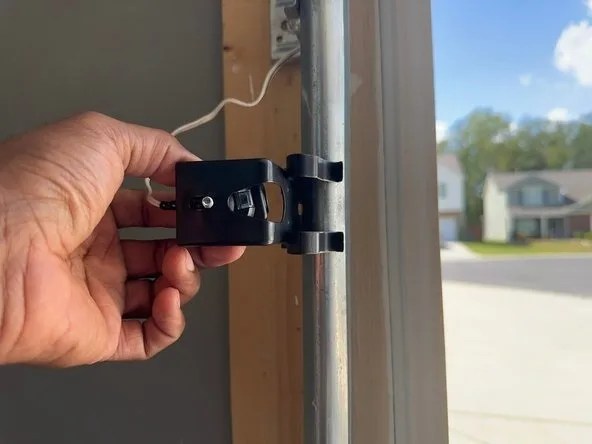
Step 4: Loosen the wing nut on the receiving sensor. Most garage door sensors are held in place by a wing nut or a small bolt on the mounting bracket. Loosen it just enough that you can move the sensor by hand but it does not flop around freely.
Step 5: Slowly adjust the receiving sensor until the green light goes solid. Gently tilt or rotate the sensor in small increments. Watch the green LED. When you hit the sweet spot where the beam is landing squarely on the receiver, the light will go from blinking to solid. You are looking for the brightest, steadiest green light possible.
Step 6: Tighten the wing nut. Once the green light is solid, tighten the bracket carefully. Do not overtighten – you want it firm enough to hold position but not so tight that you crack the bracket or shift the sensor as you tighten.
Step 7: Test the door. Press the button to close the door. It should close completely without reversing. For a proper safety test, open the door again and place a 2×4 board flat on the floor in the center of the opening. Close the door – it should contact the board, stop, and reverse. If it does, your sensors are aligned and the safety system is working correctly.
Sensors Blinded by Sunlight: The Fix
This is one of the most common and most frustrating sensor problems in Utah. Your garage door works perfectly in the morning, at night, and on cloudy days, but during certain afternoon hours, it refuses to close. The opener light blinks, the door reverses, and you end up holding the wall button down every time.
The cause is direct sunlight hitting the receiving sensor. The infrared beam that the sending sensor projects is essentially the same type of energy as sunlight. When bright, direct sun hits the receiving sensor, it overwhelms the receiver with infrared noise and the sensor cannot distinguish the beam from the ambient light. To the opener, this looks like the beam is blocked.
This problem is seasonal and time-specific. In Utah, it is most common during summer months when the sun is at a lower angle in the late afternoon, and especially on south-facing or west-facing garage doors. Homes in the Salt Lake Valley, Utah Valley, and along the Wasatch Front are particularly affected during the months when the sun angle lines up with the garage opening.
How to fix it:
- Install sensor sun shields. These are small, inexpensive tubes or hoods that fit over the sensor lens and block ambient light while still allowing the infrared beam through. They cost a few dollars and take 60 seconds to install. LiftMaster makes shields specifically for their sensors, and generic versions work with most brands.
- Swap the sensor positions. If only one side gets direct sun, try swapping the sending and receiving sensors. The sending sensor is not affected by sunlight because it only transmits. Putting the receiver on the shaded side solves the problem.
- Create a shade barrier. A small piece of cardboard tube (like a toilet paper roll) taped around the receiving sensor lens works as a temporary fix. For a permanent solution, a short length of PVC pipe or a 3D-printed shade hood does the same job.
Wiring and Electrical Problems
If cleaning and realignment do not solve the problem, and the sensor lights are not responding at all (both off) or behaving erratically, the issue may be in the wiring.
Garage door sensors connect to the opener motor unit with thin, low-voltage wires. These wires run along the ceiling and down the wall to each sensor. Over time, wires can become loose at the connection terminals, get pinched by door hardware, be chewed by rodents, or develop corrosion at the connection points.
Common wiring symptoms:
- Both sensor lights completely off: No power reaching the sensors. Check the wire connections at the opener unit and at each sensor. Look for loose, disconnected, or corroded wires.
- Lights flicker when the door moves: A wire is loose and vibration from the door’s movement breaks the connection intermittently. This usually happens at a terminal block where the wire is not secured tightly enough.
- One sensor light comes and goes randomly: A damaged wire somewhere in the run, possibly a pinch point where the wire crosses a moving component, or rodent damage.
What Causes Sensors to Go Out of Alignment
Understanding why sensors shift helps you prevent repeat problems. Here are the most common causes we see in Utah:
Accidental bumps. This is the number one cause. Someone walks past the sensor and clips it with a foot. A trash can gets pushed against it. A bicycle handlebar catches the bracket. Kids bump it while playing. The sensors are mounted at ankle height specifically to detect obstructions at floor level, but that also makes them vulnerable to contact.
Vibration from the door. Every time the garage door opens and closes, it creates vibration that travels through the tracks, the wall, and the mounting brackets. Over months and years, this vibration can gradually loosen brackets and shift sensors. Heavier doors and older openers with more vibration cause this faster.
Temperature changes. Metal expands and contracts with temperature. In Utah, where summer highs reach 100+ degrees and winter lows drop below zero, the metal tracks, brackets, and framing around the sensors shift slightly with every temperature swing. Cache Valley and the higher elevations see the widest temperature ranges.
Settling and foundation movement. Over time, homes settle. This is especially common with newer construction in areas like Draper, Lehi, and Eagle Mountain where rapid development is happening on varied soil types. Even a small shift in the garage floor or door frame can move the sensors enough to break alignment. Foundation shifts can also affect the door’s balance and spring tension, which we cover in our spring replacement cost guide.
Loose mounting brackets. The wing nuts and screws that hold sensors in place can vibrate loose over time. A bracket that was tight two years ago may have enough play now to let the sensor drift out of position.
How to Keep Sensors Aligned Long-Term
A few simple habits can prevent most sensor alignment issues:
- Keep the area around sensors clear. Do not store trash cans, brooms, bikes, or anything else within a foot of either sensor. The less traffic near the sensors, the fewer accidental bumps.
- Clean sensor lenses monthly. A quick wipe with a dry cloth takes 10 seconds and prevents dust buildup from weakening the beam over time.
- Check bracket tightness twice a year. Give the wing nuts a gentle snug during your spring and fall garage door check. Do not overtighten – just confirm they are not loose.
- Include sensors in annual maintenance. When a technician services your garage door, they should check sensor alignment, wiring connections, and bracket condition as part of the inspection.
When to Call a Professional
Sensor alignment is a safe and straightforward DIY task. But there are situations where the problem is beyond a simple adjustment:
- The green light will not stay solid no matter how you adjust it. The receiving sensor may be faulty and need replacement.
- Both sensor lights are completely off. This is a wiring or opener problem, not an alignment issue.
- Sensor lights look fine but the door still will not close. The problem is likely the opener’s logic board, the close-force settings, or a mechanical issue with the door itself. See our complete guide to why your garage door won’t close.
- The wiring is damaged, chewed, or corroded. Re-running sensor wires requires routing new cable and making proper connections.
- You have already tried everything in this guide and the problem persists. There may be an intermittent electrical issue or an opener fault that requires professional diagnostic equipment. See our complete garage door repair guide for an overview of when professional service makes sense.
Get a Free Estimate from Advanced Door
Sensors giving you trouble? We will diagnose the problem and get your door closing safely.
Serving Ogden, Salt Lake City, Provo, Park City, Logan, and all of Utah
Call for a free estimate. No pressure, no hidden fees.
Current offers: $100 off any new door or 10% off any service call
(Offers cannot be combined)
Frequently Asked Questions
Why is my garage door sensor blinking red?
A blinking red (or amber) light on the sending sensor typically indicates a wiring or connection problem. Check that the wires at the back of the sensor and at the opener unit are secure and not damaged. If the receiving sensor’s green light is blinking, that means the sensors are misaligned or something is blocking the beam between them.
How do I know which garage door sensor is the receiver?
The receiving sensor has a green LED light. The sending sensor has an amber or yellow LED light. On LiftMaster and Chamberlain systems, the receiving sensor wire connects to the white and white/black terminals on the opener. The easiest way to tell is to block the beam with your hand. The sensor whose light changes is the receiver.
Can I bypass the garage door sensors to close the door?
On most openers, holding the wall-mounted button continuously will close the door even with a sensor fault. This overrides the safety feature temporarily. However, this is not a long-term solution. The sensors exist to prevent the door from closing on people, pets, and vehicles. Fix the underlying issue rather than bypassing the safety system.
Why does my garage door only have sensor problems on sunny days?
Direct sunlight can overwhelm the infrared receiver with ambient infrared energy, making it unable to distinguish the beam from the sending sensor. This typically happens in the afternoon when the sun is at a low angle. Install sensor sun shields, swap the sensor positions so the receiver is on the shaded side, or create a physical shade around the receiving sensor lens.
How often do garage door sensors need to be replaced?
Sensors typically last 10 to 15 years or longer. They do not wear out from normal use. Most sensor problems are alignment, dirt, wiring, or sunlight issues that do not require replacement. If a sensor’s LED will not light up at all despite confirmed power, or the plastic housing is cracked and the lens is damaged, replacement is needed.
Do garage door sensors work in extreme cold?
Yes, sensors function in cold temperatures. However, frost or condensation on the lens can block the beam, and temperature-related contraction of metal brackets can shift alignment. In Utah winters, wipe the sensor lenses if you see frost and check alignment if your door suddenly starts reversing on cold mornings.
My garage door reverses after hitting the floor. Is that a sensor problem?
Not usually. If the door travels all the way down and then reverses after touching the floor, the problem is likely the close-limit or close-force settings on the opener, not the sensors. Sensors prevent the door from closing when the beam is broken. A door that reverses after fully closing is a different issue. See our guide to garage doors that won’t close for more on this.
Can LED light bulbs in my garage interfere with the sensors?
Yes. Certain LED bulbs emit infrared light or electromagnetic interference that can disrupt garage door sensors and remotes. If your sensor problems started after installing new LED bulbs in or near the garage, try switching back to incandescent bulbs temporarily to see if the problem resolves. If it does, switch to LED bulbs specifically rated as garage door opener compatible. This interference can also affect your remote, which we cover in our guide to garage doors that won’t open all the way.