
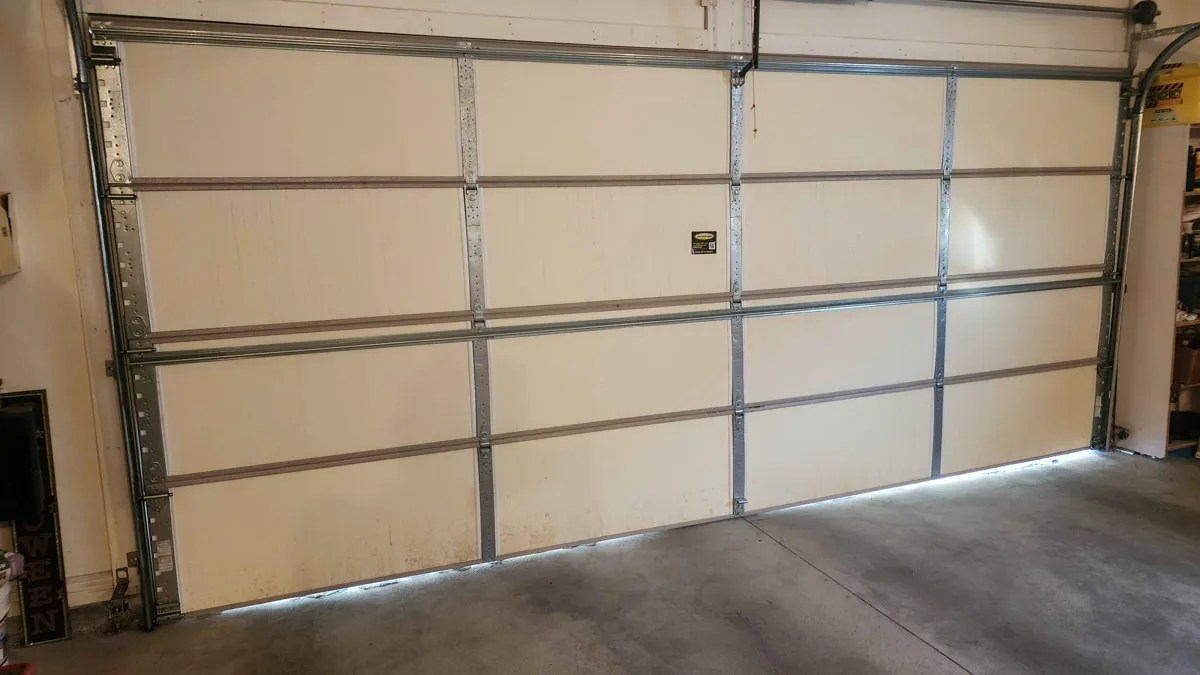
A garage door gap at the bottom is usually caused by a worn or missing bottom seal, uneven concrete from settling or frost heave, travel limit misadjustment, or a door that’s off-track or crooked. Advanced Door – Utah’s #1 rated garage door company with 4.9 stars and 30,000+ reviews – diagnoses and fixes bottom gaps same-day across Logan, Ogden, Salt Lake City, Provo, Park City, St. George, and all of Utah. Call (844) 971-3667 for a free estimate. Last updated: June 2026.
Table of Contents
- Why a Garage Door Gap Matters More Than You Think
- Quick Diagnosis: What Type of Gap Do You Have?
- Cause 1: Worn, Cracked, or Missing Bottom Seal
- Cause 2: Uneven Garage Floor or Concrete Settling
- Cause 3: Travel Limits Need Adjustment
- Cause 4: Door Off Track or Misaligned
- Cause 5: Weak or Broken Springs
- Cause 6: Bent or Damaged Bottom Panel
- Cause 7: Crooked or Uneven Door
- Cause 8: Temperature Expansion and Contraction
- Safe DIY Inspection Checklist
- How Much Does It Cost to Fix a Garage Door Gap?
- Utah-Specific Causes: Why Gaps Are So Common Here
- How to Prevent Garage Door Gaps
- When to Call a Professional
- Frequently Asked Questions
Why a Garage Door Gap Matters More Than You Think
That strip of daylight at the bottom of your garage door might seem like a minor annoyance. A little light, a bit of a breeze – no big deal, right?
Wrong. A garage door gap at the bottom is one of the most underestimated problems Utah homeowners face. What starts as a quarter-inch sliver becomes a highway for every problem you don’t want in your garage.
Energy loss. Your garage is the largest uninsulated opening in your home. Even a small gap lets conditioned air escape and outside air flood in. During Utah summers when temperatures hit 100+ degrees, or winter nights when they drop below zero, that gap can add $20 to $50 per month to your energy bills. If your garage shares a wall with your living space – and most Utah homes have at least one – the impact is even worse.
Water intrusion. Rain, snowmelt, and runoff find the path of least resistance. A bottom gap gives water a direct entry point. Over time, this causes concrete staining, stored item damage, mold growth, and can even compromise the garage floor slab itself.
Pest entry. Mice can squeeze through gaps as small as a quarter inch. Rats need about half an inch. Snakes, spiders, scorpions (especially in southern Utah), and insects need even less. Once pests establish a foothold in your garage, they migrate into your home through interior doors, utility penetrations, and wall cavities.
Dust and debris. Utah is one of the dustiest states in the country. Along the Wasatch Front, road salt dust coats everything from November through April. In southern Utah, red desert sand infiltrates any opening. A bottom gap acts like a vacuum intake every time wind gusts across your driveway.
Security risk. A visible gap signals to anyone walking by that your garage seal is compromised. In some cases, gaps large enough to slide tools or cameras under can be exploited for break-in attempts or surveillance.
SAFETY WARNING
A sudden gap that appeared overnight – especially if the door looks crooked or won’t close completely – may indicate a broken spring or snapped cable. Do not attempt to operate the door. Call a professional immediately. Broken springs are under extreme tension and can cause serious injury.
Quick Diagnosis: What Type of Gap Do You Have?
Not all garage door gaps are created equal. The pattern of the gap tells you a lot about the cause. Before you do anything else, close your garage door completely and observe the gap from inside with the lights on and garage door light off.
| Gap Pattern | Most Likely Cause | Urgency | DIY Possible? |
|---|---|---|---|
| Even gap across entire bottom | Worn/missing bottom seal or travel limits too high | Low-Medium | Yes (seal or limit adjustment) |
| Gap on one side only | Crooked door, broken spring/cable, track misalignment | High | No – call a pro |
| Gap in the center, sealed at sides | Concrete settling/heaving in center, or bowed bottom panel | Medium | Partial (threshold seal may help) |
| Gap at sides, sealed in center | Concrete settled at edges, or door bowed outward | Medium | Partial (threshold seal may help) |
| Gap appeared suddenly | Broken spring, snapped cable, track obstruction, or limit reset | Urgent | No – call a pro |
| Gap that changes with seasons | Temperature expansion/contraction of concrete or door material | Low | Yes (threshold seal + bottom seal) |
| Gap only when door is fully closed | Travel limits not set far enough, or opener force too low | Low | Yes (limit/force adjustment) |
| Irregular/wavy gap along bottom | Severely uneven floor, warped bottom panel, or multiple issues | Medium-High | Unlikely – professional assessment needed |
PRO TIP
Take a photo of the gap from inside the garage with the door closed and the overhead light off. The daylight coming through makes the gap pattern obvious and gives your technician exactly what they need to diagnose the problem before they arrive.
Cause 1: Worn, Cracked, or Missing Bottom Seal
The most common cause of a garage door gap at the bottom is the simplest one: the bottom seal (also called a bottom weatherstrip, astragal, or U-seal) has worn out, cracked, shrunk, or fallen off entirely.
Garage door bottom seals are made of rubber or vinyl and sit in a retainer channel along the bottom edge of your lowest panel. They’re designed to compress against the floor when the door closes, creating a flexible barrier against weather, water, pests, and debris.
Why seals fail:
- UV degradation. Direct sunlight on south-facing and west-facing garages hardens and cracks rubber over time. In Utah, this is accelerated by our high elevation and intense UV exposure.
- Freeze-thaw cycling. Rubber expands and contracts with temperature changes. After hundreds of freeze-thaw cycles – Utah’s Wasatch Front sees 100+ per year – the material loses elasticity and cracks.
- Chemical exposure. Road salt, de-icer, oil drips, and cleaning chemicals accelerate rubber breakdown.
- Physical wear. Every time the door opens and closes, the seal drags across concrete. Over 1,000+ cycles per year, this abrasion wears the seal down.
- Age. Even with perfect conditions, rubber seals have a 3 to 7 year lifespan depending on quality and exposure.
How to tell it’s the seal: The gap is relatively even across the entire bottom. You can see the retainer channel (a metal or plastic track) but the rubber itself is cracked, compressed flat, or missing in sections. The door itself closes fully – the gap is only where the seal should be making contact.
ACTION STEP
Bottom seal replacement is one of the few garage door repairs most homeowners can handle safely. Our complete bottom seal replacement guide walks you through the entire process step by step. If you’d rather have a pro do it, we replace bottom seals as part of routine service calls – call (844) 971-3667 for a free estimate.
Cause 2: Uneven Garage Floor or Concrete Settling
Your garage door is a rigid, flat surface. Your garage floor is not – at least, not always. Concrete moves over time, and when the floor no longer matches the straight bottom edge of your door, gaps appear.
Why concrete becomes uneven:
- Natural settling. All concrete settles over time as the soil beneath it compacts. This can take years or decades, but it’s inevitable. New construction homes in Utah are particularly vulnerable as the disturbed soil from excavation continues settling for 5 to 10 years.
- Frost heave. When water in the soil freezes, it expands and pushes concrete upward. When it thaws, the concrete settles – but often not back to its original position. Utah’s freeze-thaw cycle is relentless, especially along the Wasatch Front and in northern Utah.
- Tree roots. Root systems can push concrete up from below, creating humps and uneven spots near the garage opening.
- Poor original grade. If the concrete wasn’t poured on properly compacted soil, or if drainage routes water toward or under the slab, settling happens faster and more unevenly.
- Erosion. Water running under the slab washes away supporting soil, causing sections to drop.
How to tell it’s the floor: Remove the bottom seal entirely and close the door. If the bottom edge of the door panel itself doesn’t sit flat against the floor – meaning you can see daylight in some spots but not others along the bottom panel edge – the floor is the problem, not the door.
Alternatively, lay a long straight edge (like a 2×4 or level) across the garage floor at the threshold. Any daylight under the straight edge shows you exactly where the floor is uneven.
PRO TIP
For gaps caused by uneven concrete, a threshold seal is often the most cost-effective fix. A threshold seal mounts directly to the floor and creates a raised barrier that the bottom seal compresses against. It conforms to the floor’s actual profile rather than depending on a perfectly flat surface. For severe settling (more than 1 inch), you may need concrete grinding, mudjacking, or slab replacement before any seal will work.
Cause 3: Travel Limits Need Adjustment
Your garage door opener has “travel limits” – settings that tell the motor exactly how far to move the door in each direction. The “close” travel limit determines where the door stops when closing. If this limit is set even slightly too short, the door will stop before it fully contacts the floor, leaving a gap.
Why travel limits get out of adjustment:
- Power outage or surge. Some openers reset their limits after a power interruption, especially older models without backup batteries.
- Temperature changes. Metal tracks, springs, and the door itself expand and contract with temperature. A limit that’s perfect in spring may leave a gap in winter when everything contracts, or vice versa.
- New springs or recent repair. If springs were recently replaced or the door was serviced, the travel limits may need recalibration to account for the new spring tension.
- Opener age. Mechanical limit switches in older openers can drift over time. Digital limit systems in newer openers are more stable but can still need occasional adjustment.
How to tell it’s the travel limits: The door stops moving before it contacts the floor, but if you manually push the door down by hand (with the opener disengaged), it reaches the floor perfectly with no gap. This means the door CAN close fully – the opener just isn’t sending it far enough.
ACTION STEP
Travel limit adjustment is a safe DIY repair for most homeowners. The adjustment is made at the opener motor unit – either with a screwdriver on physical screws or via a digital panel. Our complete travel limits and force settings guide covers every major brand with step-by-step instructions. Make small adjustments (quarter turns or 1-2 clicks) and test after each change.
Cause 4: Door Off Track or Misaligned
If the vertical tracks on one or both sides of your garage door are misaligned – bent, shifted, or out of plumb – the door can’t travel its full path smoothly. This often results in the door stopping short of the floor on one side, or binding and leaving an uneven gap.
Signs of track problems:
- The door makes scraping, grinding, or squealing noises when opening or closing
- You can see rollers sitting outside the track channel or pressed hard against one side of the track
- The tracks visibly bow or bend when you look down them from the top
- The gap is consistently worse on one side than the other
- The door moves smoothly for part of its travel, then binds or hesitates near the bottom
Track misalignment can happen gradually from vibration and daily use, or suddenly from an impact (backing into the door, a child’s basketball hitting the track, or a heavy object falling against it).
SAFETY WARNING
Do not attempt to realign garage door tracks yourself. The door is held in the tracks by rollers under spring tension. If a roller pops out during a DIY track adjustment, the door can fall suddenly and cause serious injury or death. Track alignment requires professional tools and training. Read our full track repair guide to understand what’s involved, then call a pro.
Cause 5: Weak or Broken Springs
Your garage door springs counterbalance the weight of the door. When springs weaken with age or break outright, the opener may not have enough power to pull the door all the way down to the floor. The door closes most of the way, then stops an inch or two short, leaving a gap.
How weakened springs cause gaps:
As torsion springs lose tension over thousands of cycles, they no longer fully counterbalance the door’s weight. This changes the force dynamics the opener was calibrated for. The opener’s force setting may not be strong enough to push the door that final inch or two against the now-imbalanced resistance, so it stops short.
With extension springs, worn springs can also cause one side to close faster than the other, resulting in a crooked close with a gap on the lagging side.
Signs it’s a spring problem:
- The door feels heavier than normal when lifted manually
- You hear the opener straining (louder motor, slower movement) during closing
- The door closes unevenly – one side reaches the floor before the other
- The door slams down the last few inches instead of closing smoothly
- You notice a visible gap in the spring coils (broken spring) or the spring looks stretched and loose
Spring problems escalate quickly. A weak spring today becomes a broken spring tomorrow – and a broken spring means a door that won’t open at all. If you suspect spring issues, don’t wait. Read our spring lifespan guide to assess where your springs are in their lifecycle.
Call (844) 971-3667 for Spring Inspection
Cause 6: Bent or Damaged Bottom Panel
The bottom panel of your garage door takes more abuse than any other section. It’s closest to the ground, most likely to be hit by vehicles, most exposed to water and salt, and bears the full compression force of the bottom seal pressing against the floor thousands of times per year.
Common bottom panel damage:
- Vehicle impact. Backing into a partially closed door or bumping the bottom panel while pulling in. Even a minor tap can bend the bottom rail enough to create a gap.
- Corrosion. Salt spray from roads (especially in Utah’s I-15 corridor), standing water at the base, and chemical exposure can weaken and warp steel panels from the bottom up.
- Warping. Wood panels swell and warp with moisture exposure. Steel panels can bow from temperature stress. Aluminum panels dent easily from any impact.
- Worn or broken bottom bracket. The bottom bracket connects the bottom panel to the cable and roller. If it bends or breaks, the panel can twist and leave a gap on one side.
If the bottom panel is dented, bent, or corroded enough to cause a gap, replacement is usually the best option. A bent bottom panel rarely straightens cleanly, and a corroded panel only gets worse. Our panel replacement guide covers what’s involved and what it costs.
Cause 7: Crooked or Uneven Door
If your garage door hangs crookedly when closed – higher on one side than the other – you’ll have a gap on the high side. A crooked garage door is always a symptom of a mechanical problem, not a standalone issue.
What causes a crooked close:
- One broken spring (on a two-spring system) – the side with the working spring closes normally while the broken side lags
- One snapped cable – similar to a broken spring, one side loses its counterbalance
- Roller failure on one side – worn or broken rollers create friction that slows one side
- Track damage on one side – bent or misaligned track prevents smooth travel
- Hinge failure – broken or worn hinges can allow sections to sag on one side
- Opener trolley issues – if the trolley attachment point is off-center, it can pull the door unevenly
A crooked door is never a DIY repair. The underlying cause always involves components under spring tension or structural integrity. A technician needs to identify the root cause – which may not be obvious – and fix it properly.
UTAH NOTE
In Utah’s extreme temperature swings (as much as 50+ degrees in a single day during spring and fall), metal components expand and contract at different rates. This thermal stress accelerates wear on springs, cables, and rollers – all of which can contribute to a crooked door and bottom gap. A balance test twice a year (spring and fall) catches these issues before they create visible problems.
Cause 8: Temperature Expansion and Contraction
This cause is particularly common in Utah, where temperature swings are among the most extreme in the country.
What happens:
Both your garage floor and your garage door expand and contract with temperature changes. Concrete expands in summer heat and contracts in winter cold. Steel doors do the same but at a different rate. The result? A door that seals perfectly in October might have a noticeable gap in January or July.
Here’s the science: A 16-foot concrete slab can expand or contract by as much as 3/16 of an inch across a 60-degree temperature swing. That doesn’t sound like much, but when you add the door’s own dimensional changes and the rubber seal’s temperature sensitivity (rubber gets stiff and rigid in cold), you can easily end up with a quarter-inch to half-inch gap that appears and disappears with the seasons.
Specific Utah scenarios:
- Winter mornings. Overnight temperatures in the single digits cause concrete to contract and rubber seals to stiffen. A gap that isn’t there at 3 PM shows up at 6 AM.
- Summer afternoons. South-facing and west-facing garages absorb direct solar radiation. The concrete in front of the door can be 140+ degrees while the slab inside the garage is 80 degrees. This thermal gradient causes the threshold area to heave slightly, creating a gap on one side.
- Transition seasons. Spring and fall in Utah can bring 40 to 50 degree daily temperature swings. The constant expansion and contraction fatigues seals and changes the effective gap size multiple times per day.
PRO TIP
If your gap changes with the seasons, the best solution is a combination approach: a quality bottom seal on the door PLUS a threshold seal on the floor. The two seals compress against each other and accommodate dimensional changes that neither could handle alone. This dual-seal approach is especially effective for Utah homes.
Safe DIY Inspection Checklist
Before calling a technician, you can safely inspect several things to narrow down the cause. Important: Do NOT touch springs, cables, or bottom brackets. These are under extreme tension.
1. Inspect the bottom seal. Look at the rubber seal along the bottom of the door. Is it cracked, compressed flat, torn, or missing sections? Can you pull it out of the retainer channel easily (meaning it’s shrunk)? If the seal is visibly damaged, that’s likely your primary issue.
2. Check floor levelness. With the door open, lay a straight 2×4 or level across the floor where the door meets the ground. Look for gaps under the straight edge. Mark any high or low spots with tape.
3. Test the door manually. Disconnect the opener (pull the emergency release cord). Slowly lower the door by hand to the floor. Does it sit flat? If the door sits flat when manually placed but has a gap when the opener closes it, the travel limits need adjustment.
4. Look for even closure. With the door closed (by opener), observe from inside. Is the gap even across the bottom, or worse on one side? One-sided gaps point to mechanical problems (springs, cables, tracks).
5. Inspect the bottom panel. Look for dents, bends, rust, or warping along the bottom panel, especially the bottom rail and corners. Check where the bottom bracket connects to the panel – is it pulling away or bent?
6. Check track alignment. Stand inside the garage and look down each vertical track from the top. The tracks should be straight, parallel, and plumb (vertical). Any visible bowing, bending, or gaps between the roller and track wall indicates misalignment.
7. Listen during operation. Open and close the door with the opener. New or unusual sounds – grinding, scraping, popping, straining – can pinpoint the problem area. Our noise diagnosis guide covers what each sound means.
8. Check the weather. Note the current temperature and compare to when you first noticed the gap. If the gap appeared during a cold snap or heat wave, temperature changes may be the primary factor.
SAFETY WARNING
When manually testing the door, keep your hands on the door’s outer edge or a panel section – NEVER grab the bottom bracket, cable connection, or anywhere near the spring system. If the door feels unusually heavy (more than 10-15 pounds to lift for a standard residential door), stop immediately – this indicates a spring problem that requires professional attention. Read our manual operation guide for safe procedures.
How Much Does It Cost to Fix a Garage Door Gap?
The cost to fix a garage door gap at the bottom varies widely depending on the cause. Here’s what to expect for the most common repairs. These are industry-standard ranges for Utah – your actual cost will depend on the specific situation. Call (844) 971-3667 for a free estimate.
| Repair Type | Typical Cost Range | DIY Possible? | Notes |
|---|---|---|---|
| Bottom seal replacement | $75 – $200 | Yes | DIY cost: $15-$40 for the seal |
| Threshold seal installation | $100 – $250 | Yes | DIY cost: $30-$60 for the seal |
| Travel limit adjustment | $0 – $150 | Yes | Free if DIY; service call if done by pro |
| Track realignment | $125 – $350 | No | Professional only – spring tension involved |
| Spring replacement | $200 – $400+ | No | Lifetime warranty springs cost more upfront, save long-term |
| Bottom panel replacement | $250 – $800+ | No | Depends on door make/model and panel availability |
| Cable replacement | $150 – $350 | No | Usually done with spring replacement |
| Concrete leveling (mudjacking) | $500 – $1,500+ | No | Separate contractor – not a garage door repair |
| Roller replacement | $100 – $250 | Partial | Non-bottom-bracket rollers can be DIY; bottom ones require a pro |
| Hinge replacement | $75 – $200 | Partial | Center hinges can be DIY; bottom bracket hinges require a pro |
PRO TIP
Multiple causes often stack. A worn seal plus slightly off travel limits plus minor concrete settling might each contribute a small gap that wouldn’t be noticeable alone – but together they create a half-inch gap. A professional inspection identifies ALL contributing factors so you fix the complete problem once, rather than chasing individual symptoms. Our repair cost guide covers all common garage door repairs and what to budget for.
Utah-Specific Causes: Why Gaps Are So Common Here
Utah homeowners deal with garage door bottom gaps far more often than homeowners in most other states. Here’s why our climate and geography make this problem particularly persistent.
Freeze-Thaw Cycling Along the Wasatch Front
The Wasatch Front (Ogden to Provo) experiences over 100 freeze-thaw cycles per year – among the highest in the country. Every cycle pushes and pulls your concrete, your door hardware, and your seals. Over time, this creates an uneven, shifting surface that no static seal can permanently conform to.
Cities like Logan and Brigham City in northern Utah see even more extreme freeze-thaw action, with longer winters and harder freezes that push concrete further out of alignment.
UDOT Road Salt and De-Icer Corrosion
Utah applies millions of tons of road salt annually. If your garage faces a road – especially along the I-15 corridor through Layton, Salt Lake City, Sandy, and Draper – salt spray lands on your garage floor, bottom seal, and bottom panel every time a vehicle enters. This salt accelerates rubber degradation, steel corrosion, and concrete spalling. The bottom seal and panel are the first casualties.
Great Salt Lake Aerosol Corrosion
Homes within 15 miles of the Great Salt Lake – including Ogden, Roy, West Valley City, and Tooele – are exposed to salt aerosol carried by prevailing winds. This microscopic salt attacks bottom panels, hardware, and seals year-round, independent of winter road treatment.
New Construction Settling
Utah’s building boom from 2015 to 2022 produced hundreds of thousands of new homes. The disturbed soil beneath these homes continues settling for 5 to 10 years after construction. If your home was built during this period – especially in fast-growing areas like Lehi, Spanish Fork, Herriman, and Eagle Mountain – your garage floor is almost certainly still settling. Bottom gaps in newer homes often appear gradually and get worse over the first decade.
Extreme Temperature Range
Utah’s annual temperature range of 120+ degrees (from -10 in winter to 110+ in summer in southern Utah) means constant thermal expansion and contraction. St. George homeowners deal with summer heat that bakes and hardens rubber seals, while Park City homeowners contend with cold that makes seals brittle. Both extremes shorten seal life and create seasonal gaps.
Desert Dust and Sand (Southern Utah)
In Washington County, Iron County, and the desert west, windblown sand and dust act like sandpaper on bottom seals. Every gust pushes abrasive particles under the door and into the seal channel, accelerating wear. This is why bottom seals in Cedar City and St. George often fail 2 to 3 years earlier than identical seals in Salt Lake City.
UTAH NOTE
When our technicians inspect a garage door gap in Utah, we always check for multiple contributing factors. It’s rare that a Utah gap has just one cause. The combination of freeze-thaw concrete movement, salt corrosion on seals, and temperature-driven expansion usually means two or three factors are working together. A proper fix addresses all of them. Call (844) 971-3667 for a free on-site assessment.
How to Prevent Garage Door Gaps
You can’t stop concrete from settling or Utah’s temperature from swinging, but you can minimize the impact and catch problems early.
1. Replace bottom seals proactively. Don’t wait for the gap. Check your bottom seal every 6 months. If it’s compressed flat, cracked, or stiff, replace it before it fails completely. A proactive $20 to $40 seal replacement prevents hundreds of dollars in pest control, water damage, and energy loss. Our bottom seal replacement guide shows you how.
2. Install a threshold seal. If your floor is even slightly uneven – and most Utah garage floors are – a threshold seal is cheap insurance. It creates a secondary barrier on the floor that the bottom seal presses against. The dual-seal approach handles minor floor irregularities and seasonal temperature changes.
3. Maintain proper drainage. Water is the enemy of concrete stability. Make sure your driveway slopes away from the garage, gutters direct water away from the foundation, and no water pools at the garage threshold. Proper drainage slows concrete settling and frost heave.
4. Schedule annual professional inspections. A trained technician can spot developing problems – weakening springs, wearing rollers, shifting tracks – before they create visible gaps. Our maintenance schedule guide outlines what should be checked and when.
5. Lubricate moving parts regularly. Smooth-running rollers, hinges, and springs reduce vibration and uneven wear that can lead to tracking problems and crooked closing. Proper lubrication takes 15 minutes twice a year.
6. Address small gaps immediately. A quarter-inch gap today becomes a half-inch gap next season as the seal continues to degrade and concrete continues to move. Small gaps are easy and cheap to fix. Large gaps often require multiple repairs.
7. Upgrade to lifetime warranty springs. Standard springs lose tension gradually, which causes the door’s closing position to drift over time. Lifetime warranty springs with higher cycle counts maintain consistent tension longer, which means more stable door positioning and fewer gap issues from spring-related drift.
8. Run a balance test twice a year. An unbalanced garage door doesn’t close evenly. Testing the balance takes 5 minutes and can catch spring, cable, or roller problems before they create a visible gap.
Call (844) 971-3667 for a Free Inspection
When to Call a Professional
Some garage door gaps are simple DIY fixes. Others require professional equipment, expertise, and safety training. Here’s how to know which is which.
Fix it yourself if:
- The bottom seal is clearly worn, cracked, or missing – and the door itself closes straight and flat
- The gap appeared after a power outage and the door stops short of the floor (travel limit reset)
- The gap is small (under half an inch) and even across the bottom – a new bottom seal or threshold seal will likely fix it
- You’re comfortable with basic tools and can follow step-by-step instructions
Call a professional if:
- The gap is on one side only (almost always a spring, cable, track, or roller problem)
- The gap appeared suddenly (potential broken spring or snapped cable)
- The door makes new or unusual noises when operating
- The door feels heavy when you try to lift it manually
- You can see visible damage to tracks, rollers, or the bottom panel
- The gap is larger than 1 inch – even if the seal is clearly the problem, a gap that large usually has a secondary cause
- You’ve already replaced the bottom seal and the gap returned quickly
- The floor is severely uneven (more than 1 inch of variation across the width of the door)
ACTION STEP
When you call for service, mention the gap pattern (even, one-sided, center, variable), when you first noticed it, and whether it’s changed. Take that photo from inside the garage – it helps our technicians prepare the right parts and tools before arriving. Advanced Door provides free on-site estimates with no pressure and no hidden fees. Call (844) 971-3667 or request a callback at advanced-door.com.
Get a Free Estimate from Advanced Door
Gap at the bottom of your garage door? We’ll diagnose every cause and fix it right the first time.
Serving Ogden, Salt Lake City, Provo, Park City, Logan, and all of Utah
Call for a free estimate. No pressure, no hidden fees.
Current offers: $100 off any new door or 10% off any service call
(Offers cannot be combined)
Frequently Asked Questions
How do I fix a gap at the bottom of my garage door?
Start by identifying the cause. If the bottom seal is worn or missing, replace it – this is a DIY job that costs $15 to $40 for the seal. If the floor is uneven, install a threshold seal on the floor ($30 to $60). If the door stops short of the floor, adjust the opener’s travel limits. For one-sided gaps, crooked doors, or gaps that appeared suddenly, call a professional – these indicate spring, cable, or track problems that require trained repair.
Why is there a gap between my garage door and the floor?
The most common causes are a worn bottom seal, uneven concrete from settling or frost heave, travel limits set too short on the opener, a door that’s off track or closing crookedly, or temperature expansion and contraction. In Utah, most gaps involve multiple factors working together – especially freeze-thaw concrete movement combined with seal degradation from road salt exposure.
How much does it cost to fix a gap under a garage door?
A new bottom seal costs $15 to $40 for DIY or $75 to $200 professionally installed. A threshold seal runs $30 to $60 for DIY or $100 to $250 installed. Travel limit adjustment is free if you do it yourself. Track realignment costs $125 to $350, spring replacement $200 to $400+, and panel replacement $250 to $800+. Concrete leveling is $500 to $1,500+ through a separate contractor.
Can I use a garage door threshold seal to fix an uneven floor?
Yes, a threshold seal is one of the best solutions for minor floor unevenness (up to about half an inch of variation). The seal mounts directly to the concrete floor and creates a raised barrier that the bottom seal compresses against. For severe unevenness (over 1 inch), you may need concrete leveling first. Our threshold seal guide covers the full installation process.
Why does my garage door gap change with the weather?
Both concrete and garage door materials expand in heat and contract in cold. A 60-degree temperature swing can change the effective gap by up to 3/16 of an inch in the concrete alone. Rubber seals also stiffen in cold weather and become less pliable, reducing their ability to conform to the floor. In Utah, where annual temperature ranges exceed 120 degrees, seasonal gap changes are extremely common.
Is a gap under my garage door a security risk?
It can be. Gaps large enough to slide tools under can be exploited for break-in attempts. Even smaller gaps reveal information about your garage contents to passersby. A sealed bottom edge is part of overall garage door security. Additionally, any gap allows pests and moisture in, which creates secondary problems over time.
How often should I replace my garage door bottom seal?
Most bottom seals last 3 to 7 years depending on climate exposure, material quality, and usage frequency. In Utah, seals on south-facing and west-facing garages typically need replacement every 3 to 5 years due to UV exposure. Seals in salt-heavy corridors (Wasatch Front, Great Salt Lake proximity) also degrade faster. Inspect yours every 6 months and replace at the first sign of cracking, stiffness, or compression.
Can a broken spring cause a gap at the bottom of my garage door?
Yes. A broken or weakened spring changes the force balance of the entire door system. The opener may not have enough power to push the door all the way to the floor against the now-unbalanced resistance, causing it to stop an inch or two short. If one spring breaks in a two-spring system, the door may also close crookedly, creating a gap on one side. A gap that appeared suddenly with unusual noises strongly suggests a spring problem. Do not attempt to operate the door – call a professional immediately.